
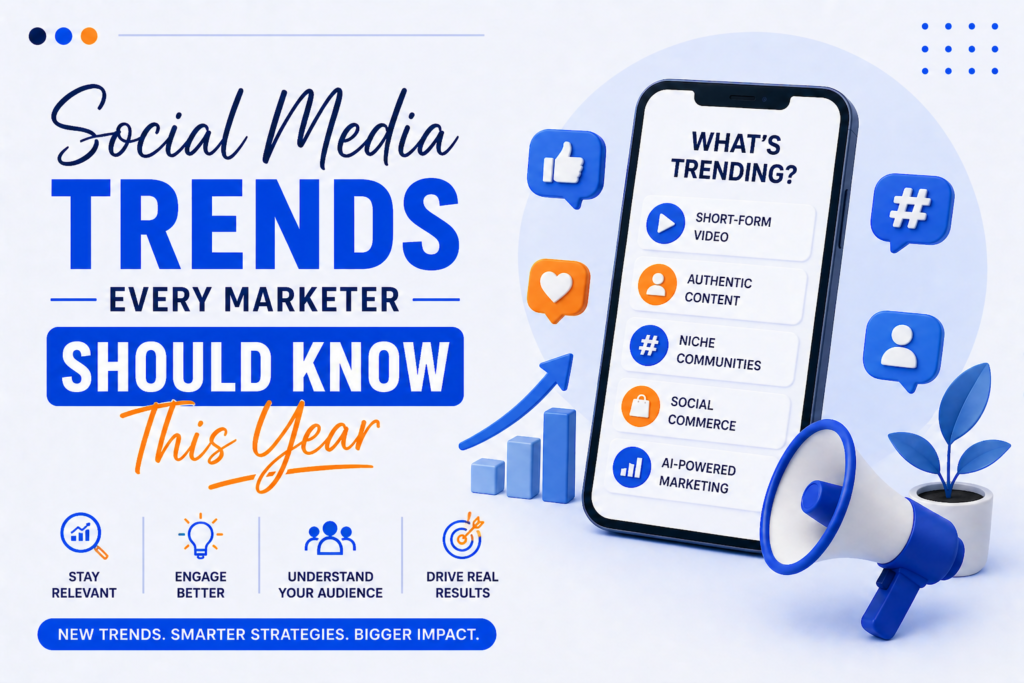
Social Media Trends Every Marketer Should Know This Year
Social media doesn’t sit still. What worked eighteen months ago — polished brand content, perfectly curated feeds, broad demographic targeting — is quietly losing ground to something faster, messier, and far more human. The platforms are shifting, audience behaviour is evolving, and the marketers who aren’t paying attention are going to find themselves optimising for a game that nobody is playing anymore.
Here are the trends reshaping social media marketing right now, and what you should actually do about them.
1. Short-Form Video Is Still King — But Quality Bar Has Risen
Reels, Shorts, and TikToks are not going anywhere. Short-form video continues to dominate reach and engagement across every major platform. But the bar has risen sharply. In the early days of TikTok, raw, unfiltered content won almost by default. Now audiences are sophisticated. They scroll past anything that feels lazy or low-effort within the first two seconds.
The winning formula has shifted to what creators call “native quality” — content that feels organic and unscripted but is clearly crafted with intention. Strong hooks in the first three seconds, fast pacing, captions for sound-off viewing, and a clear point worth making. Brands that are still treating Reels as a place to repurpose TV-style ads are getting buried.
What to do: Invest in one great short-form video per week rather than five mediocre ones. Study your best-performing posts and reverse-engineer what the first three seconds had in common.
2. The Creator Economy Has Matured — Micro Beats Mega
Influencer marketing has grown up. The era of paying a celebrity with 10 million followers to post a generic endorsement is losing effectiveness fast. Audiences have developed a sharp instinct for inauthenticity, and a celebrity holding your product with a caption that reads like a brief feels exactly as hollow as it is.
Micro-influencers — creators with audiences between 10,000 and 100,000 — are consistently outperforming their larger counterparts on the metrics that actually matter: engagement rate, conversion rate, and trust. Their audiences follow them because of a specific shared interest, which means the right micro-influencer is talking directly to your exact customer, not a diluted mass audience.
Nano-influencers (under 10,000 followers) are worth watching too. Some of the highest engagement rates on the internet belong to people with a few thousand intensely loyal followers who hang on every word.
What to do: Identify five to ten micro-influencers in your niche whose audience matches your ICP. Build a genuine relationship before pitching a paid partnership. Product gifting and collaborative content often outperforms a straightforward paid post.
3. Social Search Is Replacing Google for Younger Audiences
This one surprised a lot of marketers. A growing number of Gen Z and millennial users are now turning to TikTok, Instagram, and even Pinterest before Google when searching for recommendations, reviews, how-tos, and local spots. “Best coffee shop in Mumbai” is increasingly typed into TikTok’s search bar, not Google’s.
The implication for marketers is significant. Social content is no longer just about reach and engagement — it’s becoming a discovery channel. Your posts, captions, and hashtags are increasingly searchable, and optimising for them matters. This means writing captions with real keywords, using descriptive language in on-screen text, and creating content that directly answers the questions your audience is actually asking.
What to do: Research the top questions your ICP asks in your category. Create content that answers them directly — and write your captions as if they’re going to be found via search, not just appear in a feed.
4. LinkedIn Has Quietly Become the Best Platform for B2B Content
LinkedIn’s organic reach right now is extraordinary compared to other platforms. While Facebook and Instagram have throttled organic reach for years, LinkedIn is still surfacing content to people who don’t follow the original poster — if the engagement is strong. For B2B brands and founders, this is a rare and significant window.
The content that performs best on LinkedIn in 2025 is personal, specific, and story-driven. Founders sharing unfiltered lessons from building their companies. Marketers walking through a campaign that failed and why. Thought leaders taking a contrarian position on a widely accepted practice. Polished corporate announcements and company news perform poorly. Real, specific human stories perform extremely well.
Text-only posts are still among the highest-reach formats on the platform. Long-form carousels (PDF documents saved as posts) are also generating strong numbers. Video is growing but hasn’t hit the same ceiling yet, which means early movers still have an advantage.
What to do: Commit to posting on LinkedIn three times per week as the founder or a key team member — not as the company page. Share specific, opinionated takes. Engage meaningfully in the comments of posts from your target audience.
5. Communities Are Outperforming Broadcast Channels
The traditional social media model — brand broadcasts, audience receives — is steadily losing ground to community-led models where the audience participates rather than just consumes. Private Facebook groups, Discord servers, Slack communities, and subreddits are where some of the deepest brand loyalty is being built today.
The difference is ownership and belonging. When someone is a member of a community, they have a relationship with a group of people, not just a brand. That relationship creates stickiness, advocacy, and word-of-mouth that a follower count simply cannot replicate. Brands that have built thriving communities find that they need to spend far less on paid acquisition because their community does a significant portion of the marketing for them.
This trend also reflects a broader shift in how people want to use social media. There is growing fatigue with endless public feeds and a genuine desire for smaller, more intentional digital spaces. Smart marketers are building in those spaces rather than fighting for attention in an increasingly crowded public feed.
What to do: Identify where your most engaged customers already gather online. Start or join those spaces and focus on facilitating connection — not broadcasting your product. A community of 500 highly engaged members will drive more growth than 50,000 passive followers.
6. Authenticity Has Become a Strategy, Not Just a Buzzword
“Be authentic” has been marketing advice for so long that it started to feel meaningless. But in 2025, authenticity has become genuinely strategic, because the alternative — perfectly polished, algorithmically optimised, clearly artificial content — is everywhere and audiences are exhausted by it.
Behind-the-scenes content, unscripted founder videos, honest takes on failure, real responses to customer criticism — these are the things that cut through. Not because they are imperfect, but because they are real, and real is rare. The brands gaining momentum right now are the ones willing to drop the performance and just say what they actually think.
The fastest way to build a social media following worth having is to have a clear point of view, express it consistently, and back it up with content that delivers genuine value. Not content that looks valuable. Content that actually is.
What to do: Audit your last 30 posts. How many of them expressed a genuine opinion or shared something real? If the answer is “almost none,” you have your priority for the next quarter.
The Bottom Line
Social media in 2026 rewards specificity, humanity, and consistency more than it rewards budget or production value. The platforms change, the formats evolve, the algorithms shift — but the underlying truth stays constant: people follow people, trust voices that feel real, and buy from brands that feel like they get them.
The marketers who will win this year are not the ones who chase every new feature and trend. They’re the ones who pick a position, show up consistently, and say something worth hearing.
Start with one trend from this list. Apply it for 90 days. Then add another. That’s how momentum is built.