
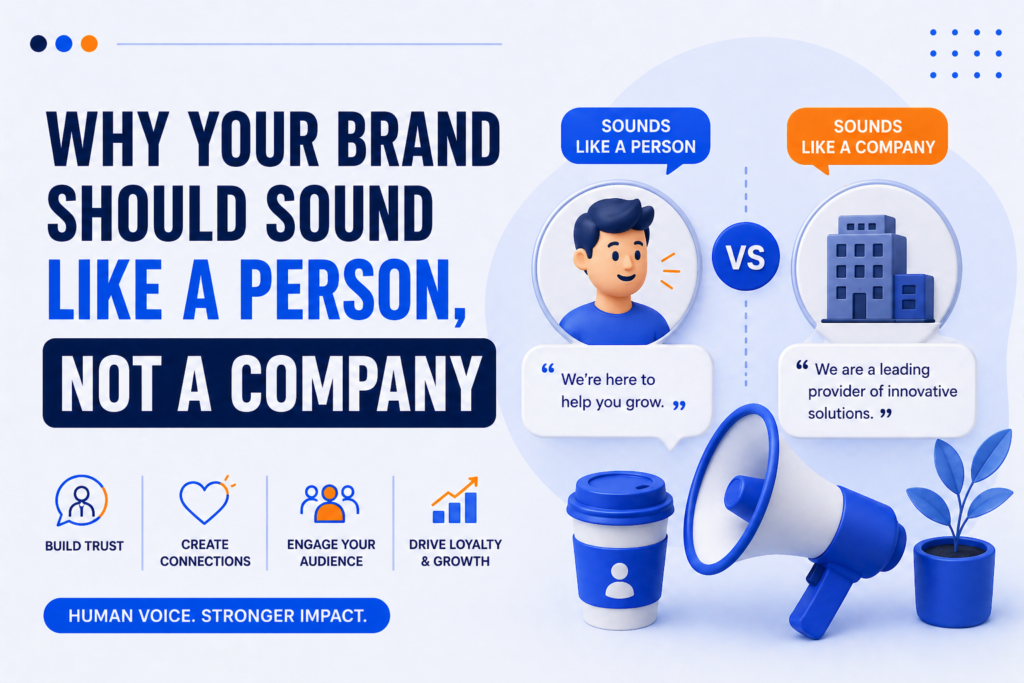
Why Your Brand Should Sound Like a Person, Not a Company
Think about the last brand email you actually read. Not skimmed — actually read, word for word. Chances are it didn’t sound like it came from a legal department. It probably felt like a message from someone who understood you, spoke your language, and had a point of view worth paying attention to.
That’s not an accident. That’s brand voice done right.
Most companies still communicate like institutions — stiff, cautious, and desperate to sound “professional.” The irony is that the more corporate a brand sounds, the less trustworthy it feels. People don’t connect with organisations. They connect with other people. And the brands that figured this out are quietly winning the attention economy while everyone else fights over ad impressions.
The Problem With Sounding Like a Company
Corporate communication has a very specific texture. You know it when you read it.
It says “leverage” instead of “use.” It says “solutions” when it means “products.” It announces things rather than saying them. It hedges every sentence to the point where nothing means anything. And it speaks at people rather than to them.
This kind of language exists because it feels safe. No one gets fired for writing a bland press release. But safe language doesn’t build brands — it erodes them. When every sentence sounds like it was approved by a committee, readers feel it. They disengage. They scroll past. They forget you the moment they close the tab.
The deeper problem is that corporate language signals something unintentional: that there’s no actual human being on the other side of the conversation. And the moment someone feels that, trust evaporates.
Why Human Brands Win
When a brand sounds like a person, something shifts in the reader’s brain. They stop processing it as advertising and start processing it as communication. That distinction matters enormously.
People are wired to respond to personality. We remember people who made us laugh, made us think, or made us feel understood far longer than we remember organisations that “delivered value.” When your brand consistently expresses a distinct human voice — one with opinions, warmth, and occasional wit — it becomes something people actually want to hear from.
Look at the brands people actively follow on social media, voluntarily open emails from, or recommend to friends. Almost none of them sound like a corporate entity. They sound like a person you’d want to grab coffee with. Someone who tells it straight, has a genuine point of view, and isn’t afraid to be interesting.
Duolingo doesn’t send push notifications that say “Continue your language learning journey.” It says “You’ve been ignoring me.” BrewDog built an entire brand identity on sounding like the passionate, slightly rebellious person who started the company. Oatly’s packaging reads like stream-of-consciousness diary entries. These brands are wildly distinct from each other, but they share one thing: they sound unmistakably human.
What a Human Brand Voice Actually Looks Like
Sounding like a person doesn’t mean being casual, using slang, or forcing humour where it doesn’t fit. It means having a consistent, recognisable personality that comes through in everything you write.
It has opinions. Humans have points of view. They believe some things are better than others and aren’t afraid to say so. A brand with opinions is infinitely more interesting than one that tries to appeal to everyone and ends up appealing to no one.
It speaks directly. Human conversation is direct. “You’re going to love this” lands better than “Customers consistently report high satisfaction levels.” Write the way a smart, confident person would speak — not the way a legal disclaimer would read.
It acknowledges reality. Real people admit when things are hard, imperfect, or uncertain. Brands that pretend everything is always excellent come across as either delusional or dishonest. Occasionally acknowledging friction, difficulty, or imperfection is one of the fastest ways to build credibility.
It has a consistent personality across every touchpoint. The voice in your email subject lines should feel like the same person as the voice on your about page, your social posts, and your error messages. Inconsistency is the giveaway that no real person is behind the curtain.
How to Find Your Brand’s Human Voice
If you’re starting from scratch, the fastest shortcut is to look at your founder or founding team. Why did they build this? What do they believe that most people in the industry don’t? What would they say about your product at a dinner party after two glasses of wine? That unguarded, direct version of the story is often where the real brand voice lives.
Some useful questions to work through:
- If your brand were a person, what would they never say? (This defines your anti-voice as much as your voice.)
- What three adjectives describe the personality you want to project?
- What does your audience find refreshing that your competitors are too scared to say?
- What’s the one belief your brand holds that a conventional company in your space would never admit?
Document the answers. Then write a short brand voice guide — two pages is enough. Include real examples of on-brand and off-brand language. Show your team what it sounds like in practice, not just in theory.
The Places Where Voice Matters Most
Voice isn’t just about blog posts and social media. The places where a human brand voice creates the most impact are often the ones people overlook.
Error messages and transactional emails. When someone’s payment fails or their order is delayed, a human voice can turn a frustrating moment into a memorable one. “Uh oh, something went wrong on our end” lands entirely differently to “Transaction unsuccessful. Please try again.”
Onboarding sequences. The first few emails a new customer receives set the tone for the entire relationship. If those emails sound like system-generated boilerplate, you’ve already started the relationship on the wrong foot.
Social media replies. How your brand responds to comments, complaints, and questions in real time is where your voice either feels genuinely human or falls apart entirely. You can’t fake this one — it shows.
Your about page. Most about pages are a graveyard of passive voice and corporate jargon. Rewriting yours in a genuinely human voice is one of the highest-leverage things you can do to build immediate trust with new visitors.
One Thing to Start Doing Today
Take your last three pieces of marketing copy — an email, a social post, a webpage — and read them aloud. If they sound like something a real person would say in a real conversation, you’re on the right track. If they sound like they were written by a committee, start rewriting.
The goal is simple: when someone reads your words, they should feel like they’re hearing from a human being who means what they say. Because in a world drowning in automated, AI-generated, optimised-to-death content, a brand that genuinely sounds like a person is rarer — and more powerful — than ever.