
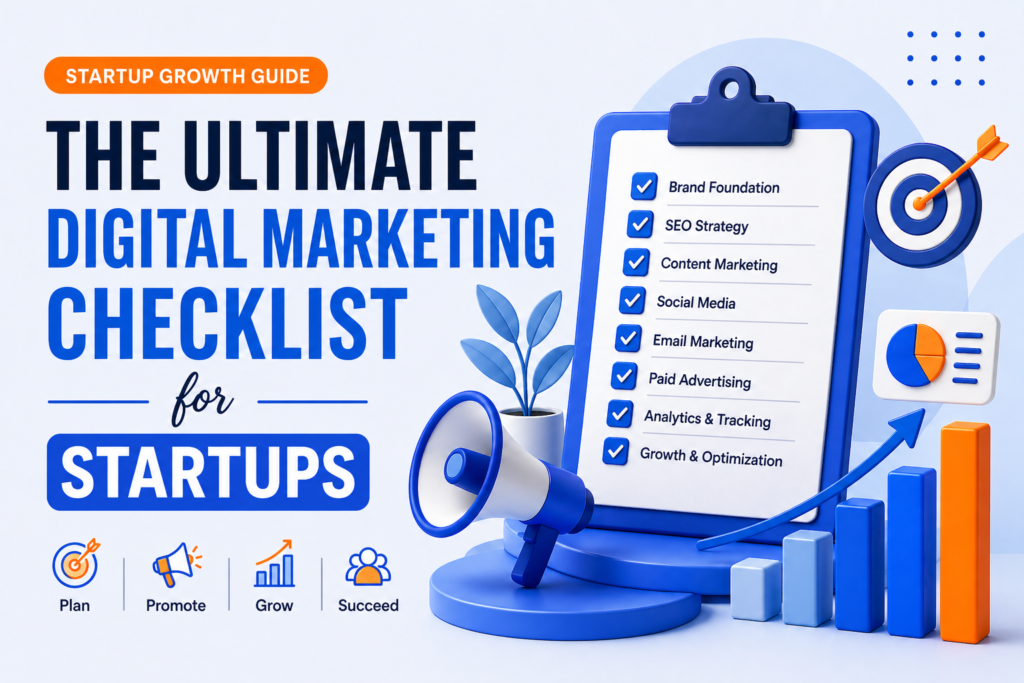
The Ultimate Digital Marketing Checklist for Startups
Most founders pour everything into building the product — then launch to silence. The truth is simple: a great product without a marketing strategy is just a well-kept secret. This checklist gives you everything you need, organized into nine categories, to build a digital marketing engine that actually drives growth.
1. Brand & Digital Foundation
Everything starts here. Marketing amplifies what’s already there — if your foundation is weak, you’ll just amplify the problems faster.
Define your Ideal Customer Profile. Go beyond demographics. Understand your customer’s goals, frustrations, and the objections that stop them from buying. Every piece of copy you write should speak to a real, specific person.
Nail your value proposition. One sentence that answers: Who is it for? What does it do? Why is it different? Run it through the “so what?” test until it genuinely makes someone lean forward.
Build a fast, mobile-optimized website. Aim for a Google Lighthouse score above 85. Over 60% of traffic is mobile — a slow or broken experience undoes every other marketing effort you make.
Create a focused landing page. One headline, one call to action, social proof, and no distractions. Remove the navigation when sending paid traffic to it.
2. Search Engine Optimization (SEO)
SEO takes six to twelve months to show meaningful results, which is exactly why you start now.
Do keyword research focused on long-tail, intent-driven terms where you can realistically compete. Map keywords to the buyer journey — awareness, consideration, decision.
Fix your technical fundamentals — sitemap submitted to Google Search Console, canonical tags, HTTPS, no broken links, and structured data on key pages.
Write unique meta titles and descriptions for every page. This is one of the highest-ROI fixes in SEO and most startups skip it.
Build internal links strategically. Create pillar pages on broad topics that link out to specific cluster content. This signals topical authority to search engines.
3. Content Marketing
Content is how you build trust at scale. The startups winning at content aren’t producing the most — they’re producing the best answers to the questions their customers are already asking.
Build a content calendar mapped to search intent. Plan 90 days ahead. Assign each piece to a funnel stage — educational for awareness, comparative for consideration, testimonials and demos for decision.
Pick one content format and go deep. Blog, podcast, YouTube, or newsletter — master one before expanding. Genuine authority on one platform beats mediocre presence on six.
Create a lead magnet people would actually pay for. A template, calculator, mini-course, or research report. Something so useful it earns the email address.
Build a repurposing system. One long-form post becomes five LinkedIn posts, one newsletter, three social clips, and an infographic. Maximize the return on every piece you create.
4. Social Media Strategy
Social gives startups direct access to their audience for free — but only if used with a clear plan.
Choose one or two platforms based on where your ICP actually is. B2B → LinkedIn. Consumer → Instagram or TikTok. Developers → X or Reddit. Pick based on evidence, not personal preference.
Optimize your profiles like landing pages. Keyword-rich bio, consistent branding, a link to your best lead magnet, and a pinned post that explains your value immediately.
Build in public. Founders who share their journey — wins, failures, lessons — build audiences faster than polished brand accounts. Authenticity compounds.
Engage before you broadcast. Spend 30 minutes daily leaving thoughtful comments on posts from your target audience. It’s free, scalable visibility that most people ignore.
5. Email Marketing
Email is still the highest-ROI channel available — averaging $36–$42 returned for every dollar spent. More importantly, you own the list. No algorithm can take it away.
Set up your ESP properly from the start. Mailchimp for simplicity, Klaviyo for e-commerce, ConvertKit for creator-led businesses. Get segmentation and automation built in early — migrating later is painful.
Build a welcome sequence of five to seven emails. Deliver value, tell your story, address objections, and guide new subscribers toward their first conversion. It runs automatically while you sleep.
Send consistently. Weekly is ideal. Inconsistency destroys trust faster than any bad campaign ever could.
Test subject lines relentlessly. A 5% improvement in open rate across 10,000 subscribers means 500 more people reading your message every single send.
6. Paid Advertising
Paid ads are accelerant, not foundation. Pour them on top of what’s already working — not on top of a broken funnel.
Know your unit economics before spending anything. LTV, target CAC, and payback period. Without these numbers, you can’t tell if a campaign is winning or burning money.
Start with Google Search Ads. Capture people already searching for your solution. Even $500 a month on three to five high-intent keywords generates real conversion data within weeks.
Set up retargeting immediately. Install your Meta Pixel and Google Tag before running any campaigns. Retargeting existing visitors typically delivers two to five times better ROAS than cold acquisition.
Test creative, not just targeting. The image, video, and copy often matter more than audience settings — especially on Meta. Allocate 20% of budget to creative experimentation.
7. Analytics & Tracking
Marketing without measurement is guesswork with a budget.
Install Google Analytics 4 and set up conversion tracking from day one. The data you collect now becomes invaluable six months later.
Define your North Star Metric — the single number that best captures the value you deliver to customers. Every marketing initiative should connect back to moving it.
Build a weekly marketing dashboard and review it every Monday. Looker Studio is free. Track traffic by channel, conversion rates, email metrics, and ad spend. Weekly review separates teams that learn fast from teams that repeat mistakes.
8. Community & PR
Earned media and community presence build trust that paid channels simply cannot replicate.
Launch on Product Hunt strategically. A well-executed launch — with the right hunter, polished assets, and a rallied network — can generate 500 to 2,000 signups in a single day.
Become a genuine contributor to niche communities. Reddit threads, Slack groups, Discord servers where your ICP hangs out. Add value for 30 days before mentioning your product.
Pitch stories, not products, to media. Journalists want angles. “We surveyed 500 founders and found this counterintuitive pricing mistake” is a story. “We launched a startup” is not.
Collect case studies continuously. One real customer story with specific results removes more purchase friction than months of advertising. Make it a monthly habit.
9. Growth & Retention
Acquiring a customer is expensive. Keeping them is cheap. Turning them into advocates costs almost nothing.
Build a referral program from day one. The moment someone experiences your product’s value is the moment they’re most likely to tell someone else. Capture that moment with a structured, two-sided incentive.
Obsess over onboarding. The biggest driver of retention is how fast users reach their “aha moment.” Map the journey, find the friction, remove it.
Talk to your customers every quarter. Five happy customers, five churned ones. Their language is your best copy. Their frustrations are your next product priorities.
Track churn proactively. Build a customer health score based on behavioral signals and trigger outreach when engagement drops. Preventing churn is always cheaper than winning customers back.
Where to Begin
Don’t try to do everything at once. Work through it in order: foundation first, then analytics, then SEO and content because they compound slowest, then email, then paid, then community and referrals as you scale.
Every great marketing operation was built one item at a time. Start with one. Check it off. Do the next.
The startups that win at marketing aren’t the ones with the biggest budgets — they’re the ones with the clearest strategy and the discipline to execute it consistently.